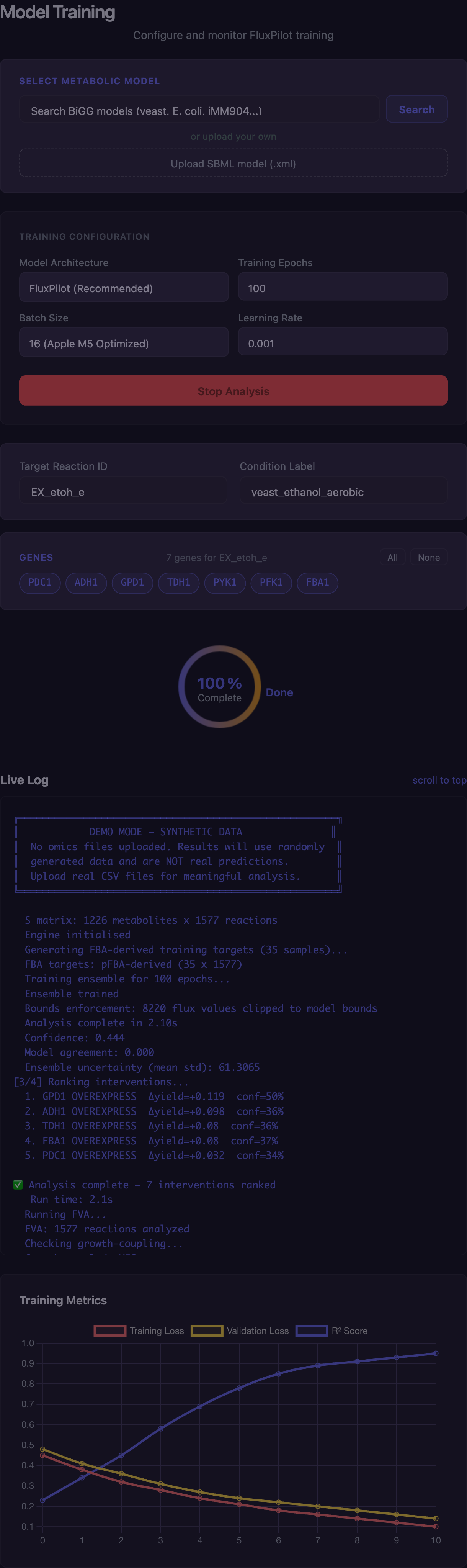
Biotech is the vertical where our method ships today. FluxPilot turns multi-omics data and a genome-scale metabolic model into ranked, safety-flagged strain designs in minutes, closing a Design-Build-Test handoff that used to take a specialist weeks. A deterministic engine produces every number; the AI plans the work and explains the result, or reports what it cannot determine.
Strain design is slow and expert-gated. A scientist spends weeks wiring transcriptomics, proteomics, and metabolomics into a model by hand, and generic AI tools invent numbers a wet lab cannot trust: a made-up kinetic constant, a lethal knockout ranked as optimal. Both cost real bench time and money.
A day-one result in minutes: interventions ranked with calibrated confidence, each flagged SAFE, CAUTION, or LETHAL, with every number produced by a deterministic constraint-based engine, and an assistant that explains each result, or flags what it cannot determine.
Bulk transcriptomics, proteomics, metabolomics and fluxomics integrated into a genome-scale model. GECKO proteomics-constrained FBA is the core capability.
Knockout and overexpression targets ranked by predicted effect, with calibrated confidence and SAFE / CAUTION / LETHAL flags, so a non-viable design never reaches the bench.
From a genome-scale model to a 96-well plate layout and an Opentrons protocol ready to run, the handoff scientists could not automate before.
Every quantitative result comes from the deterministic engine. The assistant narrates and plans; it never invents a value the model did not produce.
Same prompt, two behaviors. Typical models answer confidently regardless. FluxPilot grounds the answer, or abstains.
Run unsupervised on a real 1,514-gene × 1,055-condition E. coli expression compendium, FluxPilot's iModulon decomposition recovered the known L-rhamnose regulon: 55 of 60 components robust, 0.74 variance explained, and the top carbon-linked component is the rhaDAB + rhaT operon, with 86% of its activity governed by carbon source.
Gene identities were confirmed against the iML1515 reference model, and the whole decomposition reproduces in about two seconds. This is biological signal recovered from real data, reproducibly, the kind of proof a wet lab and a reviewer can both check.


FluxPilot is in production with a free academic tier and enterprise licensing. Tell us the organism and the objective, and we will get you set up.